
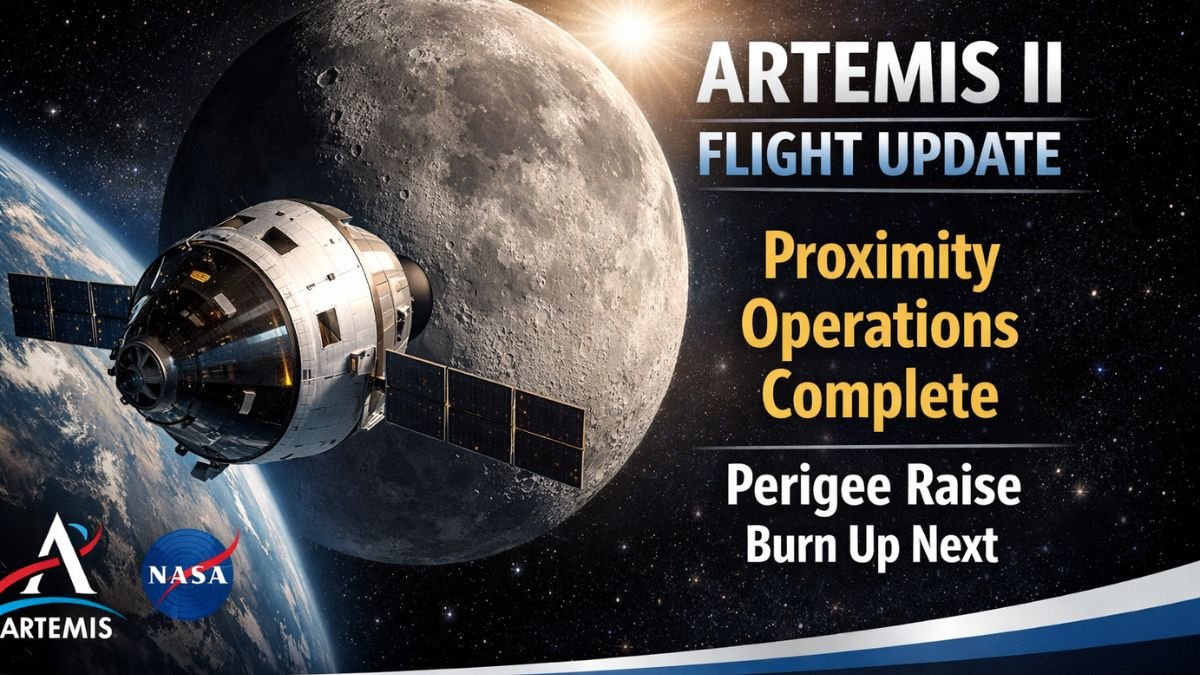
The journey back to the Moon is no longer a distant dream—it is unfolding in real time. With the Artemis program steadily progressing, Artemis II stands as one of the most anticipated missions in modern space exploration. Unlike its predecessor, Artemis I, which flew uncrewed to validate systems, Artemis II is set to carry astronauts around the Moon, marking a historic return of human presence beyond low Earth orbit for the first time in decades.
The latest update from NASA brings exciting news: proximity operations have been successfully completed, and the mission is now preparing for its next critical milestone—the perigee raise burn. While these terms may sound technical, they represent essential steps in ensuring that the spacecraft performs flawlessly in the harsh and unforgiving environment of space.
This phase is not just about engineering precision; it reflects years of planning, innovation, and collaboration. Every maneuver executed successfully builds confidence in the mission’s systems and brings humanity one step closer to a sustainable presence on the Moon.
Understanding Proximity Operations and Their Importance
Proximity operations are a series of carefully controlled maneuvers performed when a spacecraft operates near another object in space. For Artemis II, these operations are crucial for testing navigation systems, communication protocols, and the spacecraft’s ability to maneuver with precision.
During this phase, the Orion spacecraft demonstrates its ability to approach, maintain position, and move away from a target safely. These tests simulate real mission scenarios, including docking procedures and coordination with other spacecraft or modules that may be part of future lunar missions.
Completing proximity operations is a major achievement. It confirms that the spacecraft can respond accurately to commands and maintain stability in microgravity. These capabilities are essential not only for Artemis II but also for future missions that will involve assembling lunar infrastructure or supporting long-term human presence on the Moon.
The success of this phase also reflects the strength of NASA’s engineering teams, who have worked tirelessly to ensure that every system functions as intended. It is a testament to the meticulous planning and rigorous testing that define modern space exploration.
The Role of the Perigee Raise Burn in Mission Success
With proximity operations now complete, attention shifts to the upcoming perigee raise burn. This maneuver is a critical part of the mission’s orbital dynamics and plays a key role in shaping the spacecraft’s trajectory.
In simple terms, perigee refers to the point in an orbit where the spacecraft is closest to Earth. A perigee raise burn involves firing the spacecraft’s engines to increase this distance, effectively adjusting the orbit to prepare for the next phase of the mission.
This maneuver is not just a routine adjustment—it requires precise timing, accurate calculations, and flawless execution. Even minor deviations can have significant impacts on the mission’s trajectory. Engineers must account for factors such as gravitational influences, spacecraft mass, and fuel efficiency to ensure optimal performance.
Successfully executing the perigee raise burn will position Artemis II for its next steps, bringing it closer to its ultimate goal of a lunar flyby. It is a pivotal moment that underscores the complexity and precision required in human spaceflight.
Orion Spacecraft: The Heart of Artemis II
At the center of this mission is the Orion spacecraft, a state-of-the-art vehicle designed to carry astronauts safely to deep space and back. Orion represents the culmination of decades of technological advancement, combining cutting-edge systems with lessons learned from past missions.
The spacecraft is equipped with advanced navigation systems, life support capabilities, and robust shielding to protect astronauts from radiation and extreme temperatures. Its design reflects a deep understanding of the challenges associated with long-duration space travel.
Throughout the Artemis II mission, Orion will serve as both a home and a lifeline for its crew. Every system onboard must function flawlessly to ensure their safety and success. The completion of proximity operations demonstrates that Orion is performing as expected, reinforcing confidence in its capabilities.
As the mission progresses, Orion will continue to play a central role, guiding astronauts through the vast expanse of space and back to Earth. Its success will pave the way for future missions that aim to establish a sustained human presence on the Moon and beyond.
The Human Element: Preparing for Crewed Exploration
While Artemis II is still in its testing and preparation phases, it carries immense significance for the astronauts who will eventually embark on this journey. This mission represents their opportunity to push the boundaries of human exploration and venture farther than any crewed mission in recent history.
Every successful test, including the completion of proximity operations and the upcoming perigee raise burn, brings these astronauts closer to their historic flight. It ensures that the spacecraft they will rely on is safe, reliable, and capable of handling the demands of deep space travel.
The human element adds a profound dimension to the mission. It is not just about technology and engineering—it is about courage, curiosity, and the enduring desire to explore the unknown. Artemis II embodies these qualities, serving as a bridge between past achievements and future possibilities.
Building Toward a Sustainable Lunar Future
Artemis II is more than a standalone mission; it is a critical step in a broader strategy to establish a long-term human presence on the Moon. The Artemis program aims to create a sustainable framework for exploration, including the development of lunar habitats, research facilities, and infrastructure.
By validating key systems and demonstrating the capabilities of the Orion spacecraft, Artemis II lays the groundwork for future missions such as Artemis III, which aims to land astronauts on the lunar surface. Each milestone achieved during this mission contributes to a larger vision of exploration and discovery.
The completion of proximity operations and the upcoming perigee raise burn are integral parts of this journey. They ensure that the mission remains on track and that future endeavors can build upon its success.
Challenges and Precision in Modern Spaceflight
Space exploration is inherently challenging, requiring a level of precision and coordination that leaves no room for error. Every maneuver, from proximity operations to orbital adjustments, must be executed with absolute accuracy.
The Artemis II mission highlights the complexity of modern spaceflight. Engineers and scientists must work together to solve intricate problems, often under tight constraints and high stakes. The successful completion of each phase is a testament to their expertise and dedication.
The perigee raise burn, in particular, exemplifies the precision required in orbital mechanics. It is a reminder that even small adjustments can have far-reaching consequences, emphasizing the importance of careful planning and execution.
Looking Ahead: The Road to the Moon
As Artemis II continues its journey, the focus remains on achieving each milestone with precision and confidence. The completion of proximity operations marks a significant step forward, while the upcoming perigee raise burn represents the next challenge to overcome.
This mission is not just about reaching the Moon—it is about redefining what is possible in human space exploration. It sets the stage for future missions that will expand our understanding of the universe and inspire generations to come.
The progress of Artemis II serves as a powerful reminder of humanity’s ability to innovate, collaborate, and explore. It is a testament to our enduring curiosity and our relentless pursuit of knowledge.
Conclusion: A Mission That Inspires the Future
The Artemis II flight update highlights a moment of progress and promise. With proximity operations successfully completed and the perigee raise burn on the horizon, the mission continues to move forward with confidence and precision.
This journey represents more than a series of technical achievements—it embodies the spirit of exploration that has driven humanity for centuries. Each milestone brings us closer to a future where humans live and work on the Moon, paving the way for even greater adventures beyond.
As the world watches Artemis II unfold, one thing is clear: this mission is not just about reaching new destinations—it is about inspiring a new era of discovery, innovation, and possibility.
FAQs
What are proximity operations in Artemis II?
Proximity operations are controlled maneuvers where the spacecraft navigates close to another object to test precision, stability, and navigation systems.
What is a perigee raise burn?
A perigee raise burn is an engine firing that increases the spacecraft’s closest distance to Earth, helping adjust its orbit for the next mission phase.
Why is Artemis II important?
Artemis II is crucial because it will carry astronauts around the Moon, marking a major step toward future lunar landings and deep space exploration.