
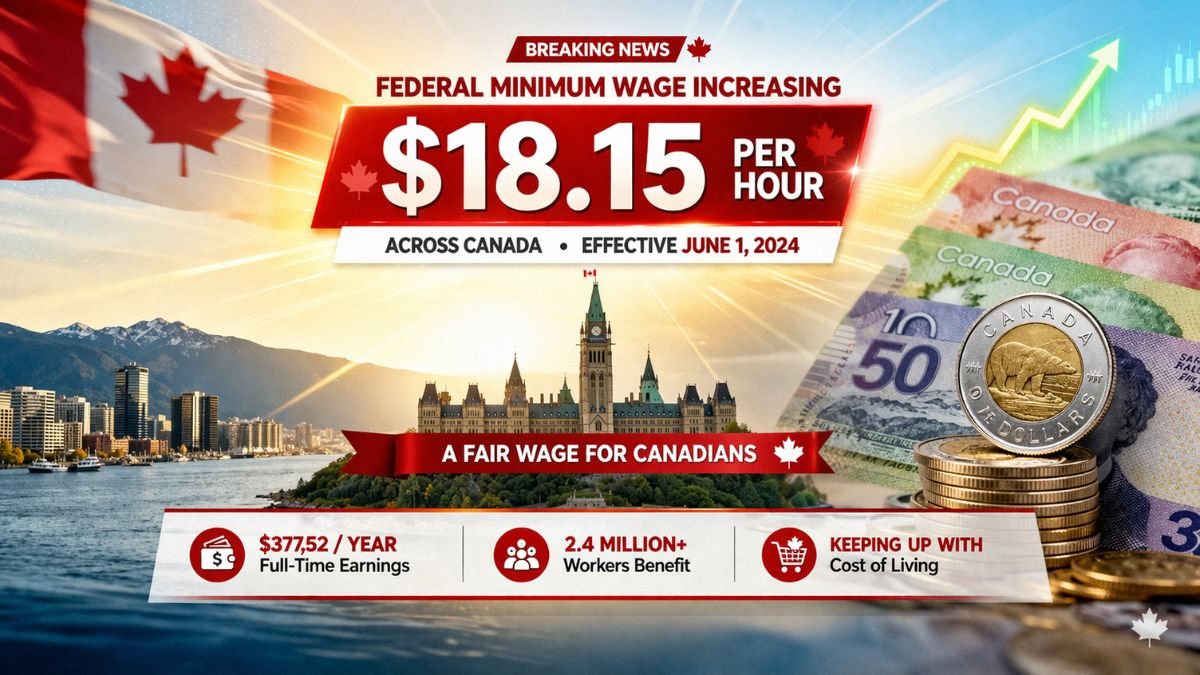
A modest increase in wages might not always make headlines, but when it comes to the federal minimum wage, even a 40-cent rise carries broader economic significance. Starting April 1, the federal minimum wage in Canada will increase from $17.75 to $18.15 per hour. While this adjustment may seem incremental at first glance, it reflects a larger commitment to keeping wages aligned with the cost of living and inflation.
The increase is part of a structured approach introduced by the federal government, ensuring that workers in federally regulated sectors are not left behind as prices for everyday essentials continue to rise. This yearly adjustment mechanism helps maintain the purchasing power of employees and offers a degree of financial predictability.
Understanding How the Wage Is Calculated
The federal minimum wage in Canada is not arbitrarily decided each year. Instead, it is tied directly to the country’s annual average Consumer Price Index (CPI), a widely used measure of inflation. For 2025, the CPI increase stood at 2.1 percent, which directly influenced the wage hike.
After calculating the percentage increase, the new wage is rounded up to the nearest five-cent increment. This ensures consistency and simplicity in payroll systems while still reflecting real economic changes. The move to $18.15 per hour is therefore not just a policy decision but a data-driven adjustment grounded in economic realities.

The Origins of the Federal Minimum Wage Policy
The concept of a federal minimum wage in Canada is relatively recent. It was introduced in 2021 under the leadership of former Prime Minister Justin Trudeau. Before this, minimum wage standards were primarily determined at the provincial and territorial levels.
The introduction of a federal standard was aimed at creating a baseline for workers in industries that fall under federal jurisdiction. These include sectors such as banking, telecommunications, and interprovincial transportation. By establishing a national floor, the government sought to ensure fairness and consistency across these key industries.
Who Benefits from This Increase
It is important to understand that not all workers in Canada will see this increase directly in their paychecks. The federal minimum wage applies specifically to employees working in federally regulated sectors. This includes jobs in airlines, railways, banks, and postal services, among others.
For the majority of Canadian workers, wages are governed by provincial or territorial laws. However, the federal rate still plays a symbolic and practical role. It often influences discussions around wage standards across the country and can set a benchmark that provinces may consider when reviewing their own rates.
Comparing Provincial and Territorial Wage Rates
Canada’s wage landscape is diverse, with each province and territory setting its own minimum wage based on local economic conditions. Currently, there is a noticeable variation across regions. For instance, Nunavut has the highest minimum wage at $19.75 per hour, while Alberta remains at the lower end with $15 per hour.
This variation reflects differences in cost of living, economic activity, and regional priorities. While the federal minimum wage of $18.15 sits somewhere in the middle, it highlights the ongoing challenge of balancing fairness with regional flexibility.
The Impact on Workers’ Daily Lives
For workers earning the minimum wage, even a small increase can make a meaningful difference. An additional 40 cents per hour may not seem substantial, but over time, it adds up. For a full-time employee working 40 hours a week, this translates into an extra $16 per week or over $800 annually before taxes.
This additional income can help cover rising costs in essential areas such as groceries, transportation, and housing. In an era where inflation continues to affect everyday expenses, such adjustments are crucial in helping workers maintain a basic standard of living.
The Employer Perspective
While wage increases are generally welcomed by employees, they can present challenges for employers, particularly in federally regulated industries. Businesses must adjust their payroll systems, manage increased labor costs, and sometimes reevaluate pricing strategies to maintain profitability.
However, many economists argue that higher wages can also lead to positive outcomes for businesses. Increased earnings often translate into higher consumer spending, which can boost demand for goods and services. Additionally, better wages can improve employee morale, reduce turnover, and enhance productivity.
Inflation and the Cost of Living Connection
The link between minimum wage and inflation is central to understanding this policy. As prices rise, the purchasing power of money decreases. Without regular wage adjustments, workers may find it increasingly difficult to afford basic necessities.
By tying the federal minimum wage to the Consumer Price Index, the government ensures that wages keep pace with inflation. This approach provides a built-in safeguard against economic fluctuations and helps maintain financial stability for workers over time.
A Step Toward Economic Balance
The annual adjustment of the federal minimum wage reflects a broader effort to create a more balanced and equitable economy. While it does not address all income disparities, it represents a commitment to fairness and economic inclusion.
For policymakers, the challenge lies in finding the right balance between supporting workers and ensuring that businesses remain competitive. The incremental nature of these increases allows for gradual adaptation, reducing the risk of economic disruption.
Public Reaction and Ongoing Debate
As with any economic policy, the increase in minimum wage has sparked a range of reactions. Supporters argue that it is a necessary step to protect workers from the rising cost of living. Critics, on the other hand, express concerns about potential impacts on employment and business costs.
This ongoing debate highlights the complexity of wage policy. While there is general agreement on the need to support workers, opinions differ on how best to achieve that goal. The annual adjustment mechanism represents a compromise, offering steady progress without drastic changes.

Looking Ahead: What the Future Holds
The increase to $18.15 per hour is part of a long-term strategy rather than a one-time adjustment. As inflation continues to evolve, so too will the federal minimum wage. Future increases will depend on economic conditions, making this a dynamic and responsive policy.
For workers, this means a degree of certainty and protection against rising costs. For businesses, it underscores the importance of planning and adaptability. And for policymakers, it serves as a reminder of the ongoing need to balance competing priorities in a complex economic landscape.
Conclusion
At its core, the increase in the federal minimum wage is about more than just numbers on a paycheck. It is about ensuring dignity, fairness, and stability for workers across Canada. While the 40-cent increase may appear small, its impact is felt in everyday lives and long-term economic health.
As the new rate of $18.15 per hour comes into effect, it serves as a reflection of the country’s commitment to keeping wages aligned with the realities of modern living. It is a step forward, however incremental, in the ongoing journey toward a more equitable society.
FAQs
What is the new federal minimum wage in Canada?
The new federal minimum wage is $18.15 per hour starting April 1.
Who is eligible for this wage increase?
Workers in federally regulated sectors like banking and transport are eligible.
Why is the wage increased every year?
It is adjusted annually based on inflation using the Consumer Price Index.