
In today’s times, when the cost of everything is rising rapidly, managing expenses related to children’s education is becoming increasingly difficult for average families. Beyond school tuition fees, items such as uniforms, textbooks, shoes, and other essential supplies also constitute a significant financial burden. This is particularly challenging for families with limited incomes, for whom purchasing a new set of uniforms every year becomes a formidable task.
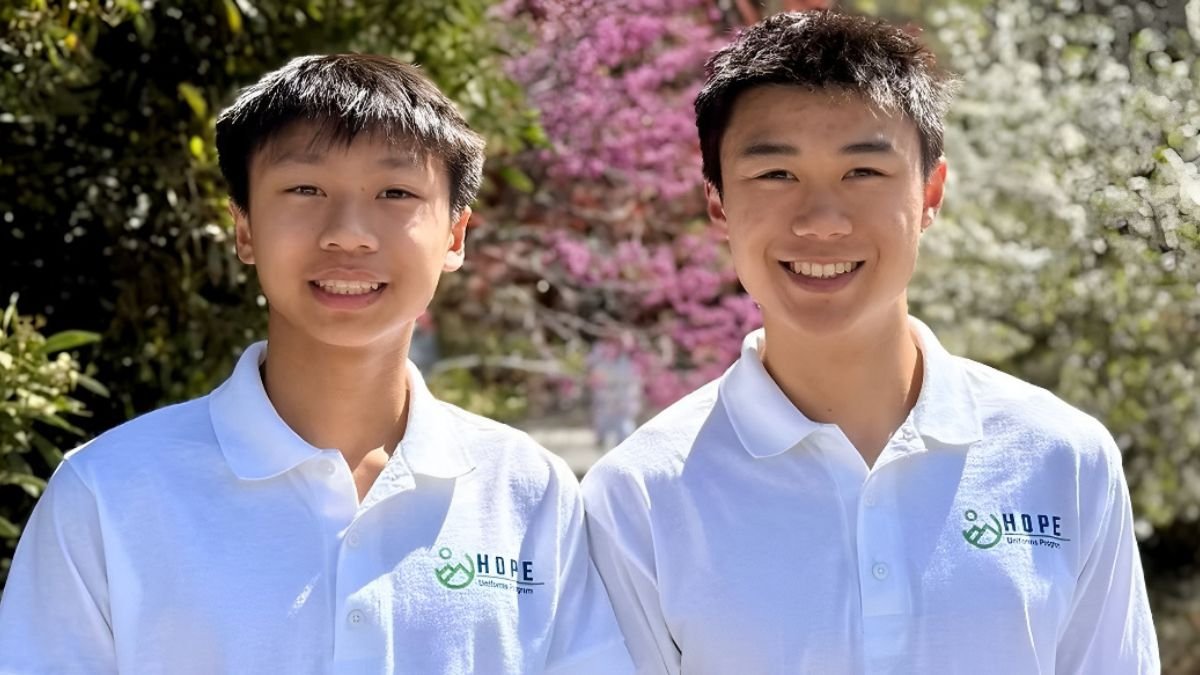
Recognizing this very problem, two teenage brothers from the San Francisco area—Desmond and Ethan Hua—launched an initiative that has not only provided financial relief to thousands of families but has also made a significant contribution to environmental conservation. To date, their unique initiative has helped over 1,400 families save approximately $140,000.
A Simple Incident Changes Everything
This inspiring story began with a very simple, yet deeply touching, incident. One day at school, Desmond and Ethan noticed a classmate wearing shorts, despite the cold weather. Puzzled by this, they asked him why he was dressed that way.
The student explained that he did not own another pair of trousers and had to make do with the shorts until his clothes could be washed. Hearing this, both brothers were deeply shaken. They realized that there were many children around them who were struggling to meet even their most basic needs.
It was at this moment that the idea struck them: why not find a solution to this problem?
The Birth of HOPE: A Step for Society and the Environment
Transforming this idea into reality, they launched a nonprofit initiative titled “HOPE: Help Our Mother Earth.” The primary objective of this initiative was twofold: to provide school uniforms to families in need while simultaneously reducing textile waste.
They observed that many families possessed school uniforms that their children had outgrown but that remained in excellent condition. Typically, these garments would either be discarded or simply left to sit unused in a closet. Through HOPE, these clothes began to be distributed to those in need.
How does this entire system work?
Desmond and Ethan transformed their home garage into a mini storage center. Here, they keep all the uniforms neatly organized, sorted by size and grade level.
This initiative operates through a two-step process:
1. Donation:
Families wishing to donate their children’s old uniforms can place the garments into collection boxes located at the school.
2. Distribution:
Families in need request uniforms based on their specific requirements. If the requested uniform is available, it is delivered to them through the school.
This entire process is remarkably simple, transparent, and effective, ensuring that assistance reaches the greatest number of people possible.
Growing Support from the School and Community
Initially, this initiative was limited to just one school, but its popularity gradually grew over time. Today, the program has expanded to cover nine schools within the San Mateo-Foster City School District.
The school administration has played a pivotal role in advancing this initiative. They granted permission to install collection boxes on school premises and helped raise awareness about the campaign among students and parents.
Members of the community also began to join the cause, transforming the initiative into a major social movement.
Financial Relief: A Major Boon for Thousands of Families
The most significant impact of Desmond’s and Ethan’s initiative has been felt by economically vulnerable families. School uniforms require replacement every year—an expense that places a heavy financial burden on many households.
Through HOPE, more than 1,400 families have collectively saved approximately $140,000 to date. This sum holds immense significance for families striving to cover their children’s educational expenses and other essential needs while living on a limited income.
A Significant Contribution to Environmental Conservation
Another crucial aspect of this initiative is environmental protection. When clothes are discarded as waste, they end up in landfills, where they decompose slowly and release methane gas. This gas is extremely harmful to the environment and contributes to global warming.
Through HOPE, approximately 13,000 uniforms have been saved from ending up in landfills so far. This has prevented the emission of nearly 30 tonnes of methane gas.
Thus, this initiative is not only helping society but is also contributing to safeguarding the planet.
A Prime Example of the Power of Youth
The story of Desmond and Ethan Hua serves as proof that while one’s age may be young, one’s vision should be grand. They have demonstrated that if efforts are directed in the right direction, young people, too, can bring about significant change in society.
They have also received accolades for this initiative. Ethan was honored with the “Dr. Cora Clemons Emerging Young Samaritan Award,” a symbol of the appreciation for his work.
Future Plans and Expansion
Given the success of HOPE, plans are now underway to scale it up to a larger level. The future goal is to expand this initiative to reach more schools and cities, ensuring that the benefits reach as many families as possible.
Additionally, they aim to raise public awareness that instead of discarding clothes, they can be reused.
Conclusion: An Inspiring Story
The story of Desmond and Ethan Hua teaches us that bringing about change does not require vast resources but rather a noble mindset and strong determination.
This simple idea—collecting old uniforms and distributing them to those in need—is proving beneficial to thousands of people today. At the same time, it is playing a vital role in protecting the environment.
This initiative serves as an inspiration to everyone to recognize the problems in our own surroundings and take small steps to resolve them. For sometimes, a small beginning is all it takes to spark a monumental change.
FAQs
Q. What is the HOPE initiative?
A. It is a program that collects and redistributes used school uniforms to families in need.
Q. Who started this initiative?
A. Two teen brothers, Desmond and Ethan Hua, started it.
Q. How many families have benefited?
A. Over 1,400 families have received help.
Q. How much money has been saved?
A. Families have saved around $140,000 on uniforms.
Q. How does this help the environment?
A. It reduces textile waste and prevents harmful emissions from landfills.